By Darren Buser, Founder, The Content Catapult
Your next technical article is due Friday, and the engineer who needs to check it is dealing with a product release. The calendar has a date. The article has a problem.
Build your technical content marketing plan around the questions you can answer and the expert time you can actually book. For a small team, a useful first quarter is three connected articles, a reusable brief, and an evidence record for deciding whether to continue, revise or keep observing.
The plan below assumes a marketing lead, a writer and a technical reviewer, with the first two roles potentially shared by one person. Its timings and output targets are planning suggestions, not industry benchmarks or promises of leads. The starter allocation is 60 hours across the pilot. Start with one product and one audience facing a specific buying decision.
What technical content marketing needs to help a buyer do
A developer evaluating an integration needs to understand what happens when it fails. A marketing paragraph about flexibility won't answer that question.
Technical content marketing explains a technical subject in enough depth to help a prospective customer evaluate a problem, approach or product. It connects the technical detail to a buying decision through evidence, examples and explicit limitations. Tutorials, comparison guides and implementation checklists can all do that job.
For this plan, focus on buyer-facing articles. Keep ongoing API references and support documentation with their existing owners. You can cite those materials without quietly taking responsibility for maintaining them.
We'll use a fictional B2B company that sells webhook-monitoring software throughout. Its marketing team wants to help engineering managers evaluate duplicate-event handling. The company, team and assignments are illustrative; the technical sources are real. Nothing in this example represents a client engagement or measured result.
The editorial question is specific: what should an engineering manager check before trusting an integration with repeated events? That gives you something to commission, review and use in a sales conversation.
Set a technical content marketing budget in hours
Before approving three articles, put the work into your team's calendar. Use this starter allocation for the whole pilot, then replace it with your own estimate after the first piece.
| Work | Suggested pilot allocation | Accountable role |
|---|---|---|
| Buyer questions, existing-content audit and briefs | 10 hours | Marketing lead |
| Research and drafting, three articles | 24 hours | Writer |
| Interviews and technical review | 6 hours | Technical reviewer |
| Editing, publishing, distribution and measurement | 14 hours | Marketing lead/editor |
| Rework allowance | 6 hours | Marketing lead |
| Total | 60 hours | Pilot owner |
These are illustrative effort allowances, not rates or a prediction of how fast a writer should work. They exclude original experiments, a new analytics setup and regulated approval. Price external help separately. If those jobs are required, add capacity or reduce the deliverables before starting.
The important negotiation is access to the reviewer. Six hours reserved in principle is different from a booked interview and review slot. If expert time shrinks, reduce the pilot to one article and its checklist. If no qualified reviewer is available, hold publication. Don't turn missing review capacity into a request for faster drafting.
If you need outside help, start by scoping a technical writer's assignment. Give the writer a defined buying question, available sources and a named reviewer before comparing quotes.
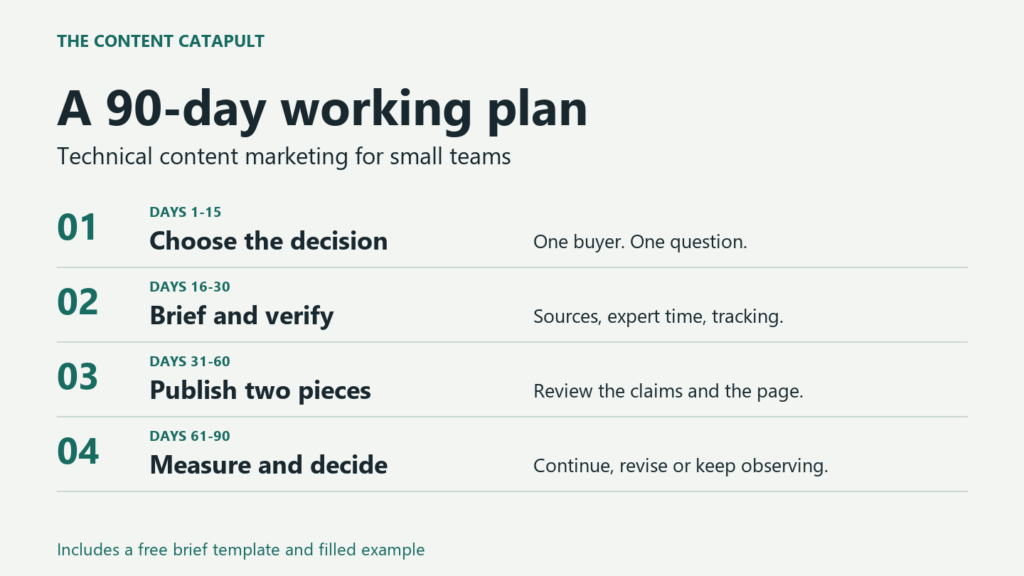
Days 1-15: choose one buying decision
Open recent sales questions, support tickets and your existing articles together. Look for a decision that buyers are struggling to make and that your team can explain with evidence.
Write down five candidate questions. Beside each, record the buyer's role, where the question appeared, its connection to your product and who could verify the answer. If a question came from brainstorming rather than a customer, label it as a hypothesis.
Choose a question only when you can name both the buyer's next action and the evidence you'll use. Search volume can help prioritize candidates, but don't let it substitute for those two answers.
For the fictional webhook vendor, the pilot could look like this:
| Buyer question | Article assignment | Evidence needed |
|---|---|---|
| Why might the same event arrive again? | Explain repeated delivery and the questions it raises | Provider documentation and expert explanation |
| What should we test before launch? | Build a duplicate-event evaluation checklist | A clearly scoped test scenario, reviewed by an engineer |
| Should we build monitoring or buy it? | Compare ownership, visibility and maintenance responsibilities | Documented requirements and verified product capabilities |
These pieces share a buying decision without answering the same question three times. The comparison article is conditional: if you can't verify the product capabilities, keep it as a neutral requirements guide.
Check what you already have before opening a new document. Refresh an existing page if it answers the same question for the same reader. Keep a short record of the URL, proposed change and reason, so a second writer doesn't commission it again next month.
By day 15, approve the assignments and reserve the expert sessions. A topic list without review access is still a wish list.
Days 16-30: write the brief and book the review
Give the reviewer a decision to check, not a blank page to fill.
Each brief should state the reader's situation, the question the article answers, the action the reader should be able to take and the claims the writer must avoid. Add the sources, a short outline and the person responsible for final approval.
Then create a claim table. For the webhook example, one row might say:
| Proposed claim | Evidence | Boundary | Review decision |
|---|---|---|---|
| A Stripe webhook endpoint can receive the same event more than once | Stripe's webhook documentation | No frequency estimate; no claim that a repeated event automatically creates a duplicate charge | Check the wording against the source |
Stripe documents repeated receipt of the same event. That supports the narrow statement in the table. It does not establish how often your buyer experiences it, what it costs them or whether the fictional vendor prevents it.
Use the expert interview to fill those boundaries. Ask what a novice would misunderstand, which conditions change the answer, what would make a proposed test invalid and which product claims require a demonstration. Ask for the source or artifact that supports each answer.
Keep the interview and approval separate. A conversation supplies material; approval confirms the final words. In Oleksii Klochai's account of building a technical content process, technical peer review and editing are distinct checks. That is a useful division of responsibility for this pilot too.
Agree a review deadline and a backup reviewer. If neither can approve the technical claims, hold publication or remove the affected claims and have the narrower version checked. Silence is not a verdict.
Before the first publication, record available baselines and test the intended download or contact tracking. Mark missing data as unavailable.
Days 31-60: publish two pieces that pass the same checks
Draft the explanation first, then the evaluation checklist. Use the first article to test your brief and review process before commissioning a larger batch.
Give the writer access to the approved sources, interview notes and claim boundaries. AI can be assigned outlining or drafting work within that packet, but retain a person responsible for opening each source and checking the resulting claim. The source-controlled AI-assisted writing workflow explains that division of work.
For each article, run four separate checks:
- The writer checks whether the draft answers the agreed buying question and removes repetition.
- A second reader checks the argument, assumptions and arithmetic without relying on the writer's summary of what is correct.
- The technical reviewer checks the product behavior, examples and limits against sources or test evidence.
- The marketing owner checks the reader's next step, links and published page.
One person may cover multiple roles in a small team. Keep the second read separate from the writing session, and record who made each decision. If nobody can verify a technical demonstration, don't publish it as tested.
For the fictional checklist, a proposed test is to replay an event in an isolated test environment and examine what the application does. The engineer must define the setup and expected behavior before the article gives operational instructions. Until then, describe it as an evaluation question, not a runnable procedure.
Publish when the brief's acceptance criteria are met. A word target can help scope the assignment, but Google says it has no preferred word count. Stop when the reader can make the promised decision and the claims survive review.
After the first piece, compare actual effort with the allocation. If technical review consumed more time than expected, adjust the second assignment before the same problem arrives wearing a new title.
Days 61-90: distribute, measure and choose the next cycle
Put the checked articles where the buying question already comes up. Give sales a short note explaining who each article is for and when to send it. Share an excerpt through an existing email or social channel, with a link to the full explanation. Answer relevant community questions only where participation and links fit the community's rules.
Record what you did and when. Start with these measures, using definitions agreed before publication:
| Signal | Where to record it | Decision it supports |
|---|---|---|
| Relevant search queries, impressions and clicks | Search Console, filtered to the article | Is the page appearing for the intended question? |
| Recorded template downloads or contact actions | Analytics, with test activity excluded | Is the next step being used? |
| Sales use and the buyer's response | CRM note with the article URL | Which objection does the article help discuss? |
| Accepted inquiries or opportunities with a recorded content interaction | CRM, deduplicated by opportunity | Is there evidence of commercial contribution? |
Set up and test the tracking before judging a blank report. A download is an action, not automatically a qualified lead. Define qualification with sales, for example an inquiry from the target company type about a relevant implementation need.
Keep observed contribution separate from caused revenue. Google describes attribution as assigning credit along a user's path; a credited interaction alone does not establish what would have happened without the article. For a fuller reporting framework, use the guide to content-to-pipeline measurement.
Release the third article only if the first two passed review and the remaining effort fits the budget. At day 90, choose explicitly: continue the topic, revise the content or pause it. Relevant buyer questions support another assignment. Irrelevant traffic calls for a topic or positioning change. Sparse data calls for a longer observation window, not a confident verdict that the pilot worked or failed.
Use the technical content brief template
Download the blank brief as text and the filled B2B example as text. Both are ungated: copy them into your preferred document editor. The blank version gives you fields for the buying question, evidence, expert access, claim boundaries and publication criteria. The filled version shows how those fields connect for the fictional webhook vendor.
The most important field is the claim boundary. For example: "Explain repeated event delivery using the provider's documentation. Do not claim our product prevents duplicate charges, publish a failure rate or imply a customer result without separate evidence."
That sentence gives the writer permission to be specific and a clear place to stop. Complete the evidence table before assigning a draft. A list of source URLs is useful only when someone knows which statement each source supports.
Keep the brief with the published article's record. Add the final reviewer, approval date and a review trigger, such as a provider-documentation change or a changed product capability. The next writer should be able to see why a claim was allowed.
Give the next quarter a stopping rule
Before expanding the program, decide which existing work will leave the calendar to make room. Include maintenance of the first three pieces in that decision. A growing library brings a growing set of claims your team still owns.
Choose a person who can pause publication when the evidence changes. Put their name in the brief. Make that commitment before approving another batch of posts.