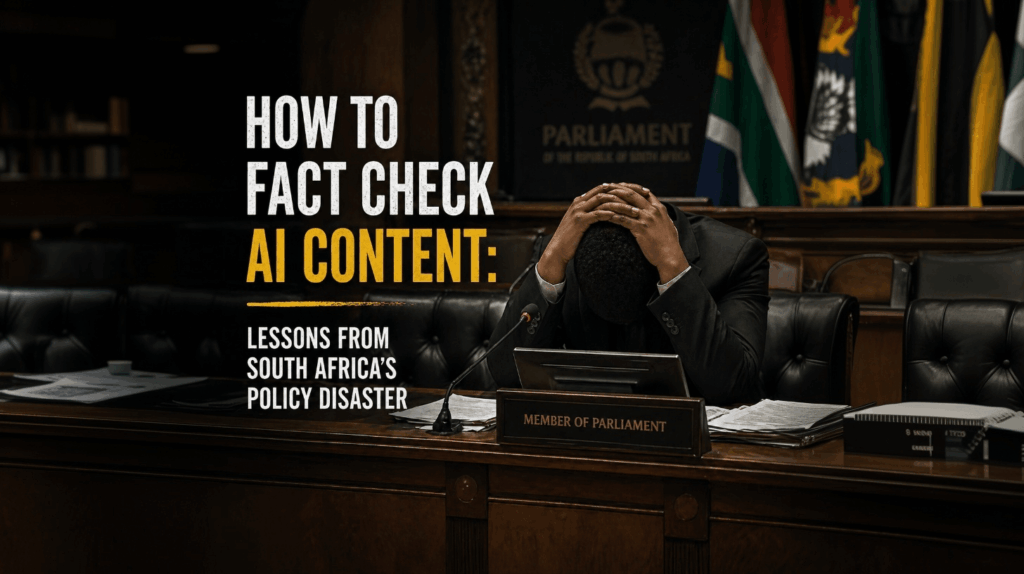
South Africa’s government published a national AI policy, built partly with AI tools, without a process for how to fact-check AI content before it goes public. On 26 April 2026, the Communications Minister withdrew the document after internal investigations confirmed that it contained fictitious academic citations: references to non-existent papers, attributed to authors who never wrote them.
The draft had cleared Cabinet approval on 25 March and had been live for public comment since 10 April. It took three weeks and a single piece of investigative journalism to expose what the government’s own quality assurance had missed: AI-generated text, passed off as research, dressed in the grammar of credibility. Nobody had checked whether the sources were real.
This failure is not exotic. It is the default outcome when AI-generated content is subjected to a review process designed for human-written content.
For B2B teams in regulated or technical markets, where buyers read citations and understand the literature, the stakes are not public embarrassment. They are a technical buyer who clicks your link, reads the original source, and decides your company does not understand its own subject. The five-step process in this article is how you prevent that.
South Africa’s policy collapse is a case study in fact-checking AI content and getting it wrong
The ministerial statement was direct: ‘The most plausible explanation is that AI-generated citations were included without proper verification. This should not have happened.’

News24’s investigation identified at least six references in the document that were completely fictitious. The Citizen reported that some of the document’s 67 cited sources either do not exist or point to non-peer-reviewed material. Authors credited with foundational research had never written on those topics. The journal titles looked authoritative. The references were invented.
Before the story broke, the department described the problems as ‘minor referencing discrepancies’ that did not affect the substance of the policy. The minister’s position, issued the same day, was the opposite: ‘This failure is not a mere technical issue. It has compromised the integrity and credibility of the draft policy.’
From ‘minor discrepancy’ to ‘policy withdrawn’ in a single news cycle. That is what happens when misleading content built on fabricated sources reaches an audience that can verify it.
A government faces a breaking news story and a public investigation. A B2B company faces the quieter, more damaging version: a buyer who says nothing and stops returning calls.
Why AI-generated content breaks standard fact-checking processes
Large language models, the neural networks underpinning generative AI tools, AI chat assistants, and AI-powered drafting software, do not retrieve facts from verified databases. They predict the most statistically probable next word based on patterns learned from their training data. When the model hits a gap in that data, it generates something plausible rather than flagging uncertainty. This is the mechanism behind every fabricated citation.
The output does not look like an error. It looks like a credible list of sources.
Research published in January 2025 and cited across multiple AI benchmarking reports found that AI models were 34% more likely to use phrases like ‘certainly’ and ‘without doubt’ when generating incorrect information. The output sounds most confident precisely when the underlying data is wrong.
Standard editorial review does not catch this because it was built for human-generated content. A human writer who cites a study has, at minimum, opened it. An AI model generating a citation has not. A QA process that checks whether citations appear in the text, without checking whether the sources exist and say what the article claims, will fail on AI-generated content every time.

The two citation errors that make AI content hard to verify
When you fact-check AI content with inaccurate citations, two specific failure modes emerge that a standard link check will not surface.
Attribution mismatch. A real statistic from real data, attached to the wrong source. The AI model has taken a figure from one context and cited it via a different document, often one that sounds more authoritative. When you cross-reference the cited source, the number is not there. When you search for the figure in the original source, you find it attributed to entirely different research, a different year, or a different population.
Conclusion mismatch. The cited paper exists. The URL resolves. You can access the document. But what the source actually concludes does not match the directional claim the article makes. The study found a correlation; the article presents it as causation. The data covers a narrow context; the article applies it broadly. A technical buyer who opens the link for a closer look will quickly find the discrepancy. This is the failure mode that slowly erodes credibility rather than all at once.
Both failure modes survive any fact-checking process that stops at confirming a URL resolves. Neither is detectable without reading what the source says, compared with what the article claims it says.
How to fact-check AI content: a five-step process that goes to the claim
This process applies to any AI-assisted content where accuracy determines credibility: technical articles, white papers, regulatory documents, and any post where a buyer might verify what you wrote. It is designed to do the heavy lifting that AI tools cannot, confirming that the specific claim in the text is accurately represented in the cited source.
1. Extract every factual claim before you touch a source. Go through the AI-generated content and list every statistic, date, attribution, comparison, and named reference. Include the conclusion and closing paragraphs, where unchecked assertions accumulate. Do not trust the AI model to signal which claims need verification. It will not. Produce a complete list first.
2. Retrieve the original source directly. For every claim on your list, go to the original source: the study, the press release, the official document. Not a secondary article that cites it, not an AI-generated summary. Outdated information and misattributed figures routinely survive secondary-source checks. Only the original source tells you what was actually said.
3. Verify attribution: confirm the exact figure came from this specific document. Locate the sentence or data point in the source that corresponds to the claim. If you cannot find it, the citation is wrong, regardless of whether the same figure exists somewhere else. Cross-reference the cited document directly. This is where attribution mismatches get caught.
4. Verify the conclusion: check what the source actually says. Read the source’s own conclusion, not just the abstract. Confirm that the directional claim the article makes is the claim the source supports. If the research found an association, the article cannot assert a cause. If the data covers one context, it cannot be generalized to all. This is where conclusion mismatches get caught, and where most fact-checking processes stop too early.
5. Label every claim before it leaves the draft. Claims that pass all four steps get marked VERIFIED with the source URL. Claims that cannot be confirmed against a live, accessible source are explicitly flagged as unverified or removed. Nothing labeled unverified enters the published version. This step is also your editorial record: what was checked, by whom, and when.
This process will not be fully automated. The verification step requires a human to read the source and judge: Does this source say what the article claims it does? AI tools can help locate sources and flag surface-level mismatches. They cannot determine whether a paper’s conclusion supports a specific causal claim. That judgment still belongs to a person.
The tools that support AI fact-checking and what they cannot verify alone
Several tools are positioned as solutions to the AI accuracy problem. It is worth being precise about what each can and cannot do.
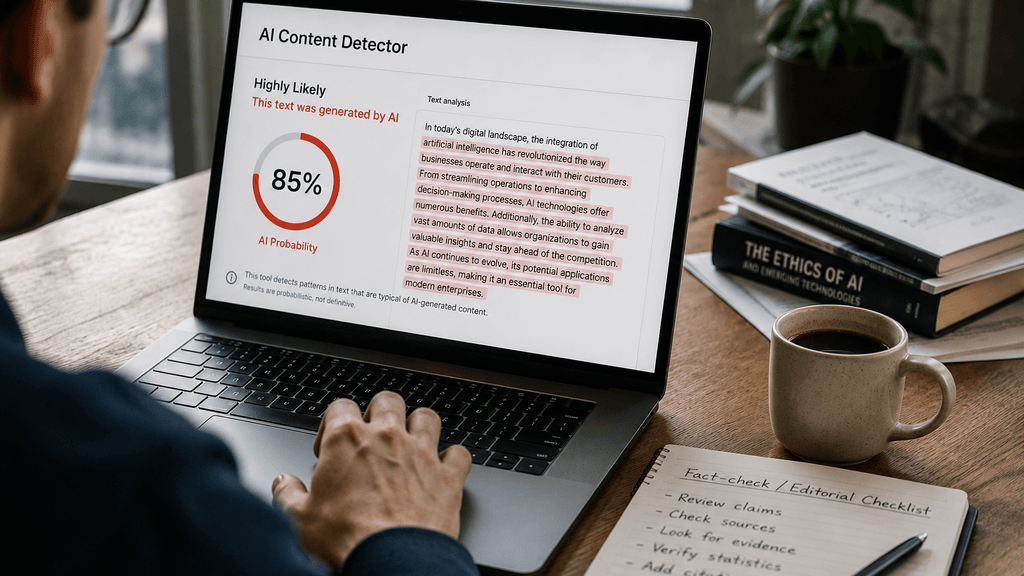
AI detectors, designed to determine whether text was AI-generated, are useful as prompts for additional scrutiny, not as verification tools. Their false positive rates on human-written content are high enough that a clean result cannot be taken as confirmation of accuracy. AI-generated text that has been lightly edited will often pass. Use them to identify where to look more closely, not to confirm that a piece is accurate.
Browser-based fact-checking tools, including those available as Chrome extensions, can surface known misinformation patterns and flag established false claims, particularly around breaking news and current events. They check whether a claim has been flagged by fact-checkers as misleading. They were not built to verify whether a specific citation in your article accurately represents the data it cites. Those are different tasks.
Search and cross-reference remain the most reliable method for claim-level verification. Identify the original source of each data point. Go directly to the institution, the journal, or the company that produced the data, not the article that cited it. Compare what the source actually says to what the AI-generated content claims it says. Multiple sources containing a similar figure are not confirmation that any one of them is accurately cited. Consulted directly, trusted sources are more reliable than aggregators.
Bad actors can exploit any content format, but the more common and more expensive problem is not malicious fabrication. It is an AI model that fills a gap in its training data with a plausible-sounding citation that no one checked. The fix is the same in both cases: a human reading the source against the claim.
What accurate AI content looks like when the process is followed
South Africa’s policy failure makes one thing clear: the credibility of AI-generated content is not determined by how it reads. It is determined by whether someone verified it.
The document that was withdrawn read like authoritative policy until a journalist checked the references. Nothing in the text indicated that anything was wrong. The fabricated citations were formatted correctly, the authors’ names were plausible, and the journal titles looked real. Every signal said: credible source. None of those signals was accurate.
This is what makes AI-generated content specifically dangerous in technical markets. Human-written content that contains errors usually contains errors you can see: vague claims, thin sourcing, copy that does not sound close to the product. AI-generated content that contains errors looks like the real thing. The problem is invisible until someone checks.
The five-stage pipeline is built around that specific risk.
Stage 3 of the pipeline is a dedicated fact-check: every claim in the draft is traced back to its cited source, the source is opened, and the content of that source is checked against the claim as written. Not whether the URL resolves. Whether the source says what the article claims it says. Attribution mismatches and conclusion mismatches, the two failure modes described above, are caught at this stage before the article reaches a reader. The human review model behind that step is explored in Will AI Replace Technical Writers?.
Stage 4 runs three research-based reader personas against the draft, identifying what lands, what confuses, and what a buyer in each role would do next. The pipeline was stress-tested in a medtech regulatory environment, where the cost of a wrong claim is not a credibility problem: it is a compliance problem. It has been running for clients in B2B SaaS, industrial tech, and regulated markets for over eight years, with a 100% Job Success Score and $900K+ in verified earnings on Upwork.
If your content team is producing AI-assisted articles without a step to verify the claim against the source, the Technical Article Content Engine explains how the pipeline handles this.